Xinyuan’s research focuses on developing principled statistical and machine learning methods to advance our understanding of the human brain and its relationship to cognition and disease.
Bayesian Deep Learning for Dynamic Brain Connectivity
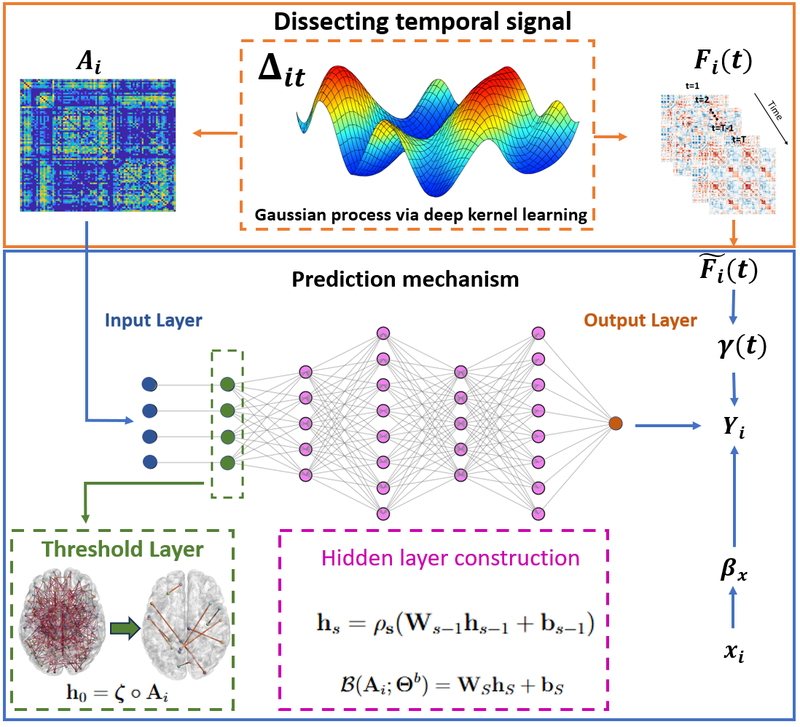
This work proposes a Bayesian deep learning framework that decomposes functional connectivity into dynamic and stationary components, disentangling transient fluctuations from stable network structures. Leveraging deep kernel learning and thresholded Gaussian processes, the model captures temporal dynamics while maintaining interpretability through sparsity-inducing layers. Applied to the ABCD study, the framework uncovers dynamic brain signals during cognitive tasks that significantly contribute to cognitive performance.
Tian X., Guo Y., Ding S., Zhang Y., Esserman D., & Zhao Y. In revision, Biometrics, 2025.
Mediation and Pathway Analysis with Brain Network Mediators
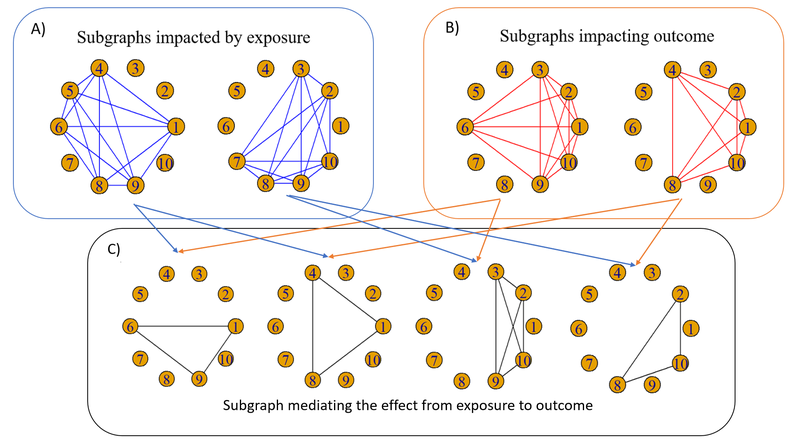
This line of research develops pathway and mediation analysis methods that incorporate brain connectivity networks as mediators linking genetic exposures to clinical outcomes such as Alzheimer's disease survival. The proposed approach identifies truly mediating subgraphs — subnetworks that simultaneously respond to genetic exposure and influence disease outcomes — providing mechanistic insights into how risk factors affect neurodegeneration through brain structural pathways.
Tian X., Li F., Shen L., Esserman D., & Zhao Y. Biometrics, 80(4), ujae132, 2024.
Bayesian Longitudinal Network Regression for Connectome Genetics
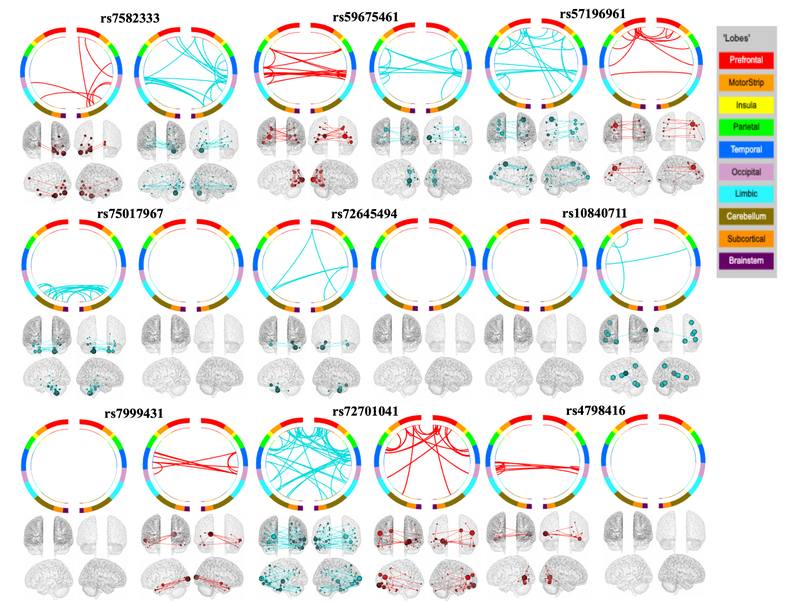
This project develops Bayesian frameworks for modeling the relationship between genetic factors and brain connectivity networks measured longitudinally. The proposed mixed-effect model enables principled inference on how genetic variants shape the brain's functional organization over time, identifying SNP-associated sub-network structures through network-level regression with biologically meaningful decompositions applied to large-scale imaging genetics data.
Li C.*, Tian X.*, Gao S., Wang S., Wang G., Zhao Y., & Zhao Y. Statistics in Medicine, 44(8–9), e70069, 2025.
Bayesian Semiparametric Methods for Complex Biomedical Data
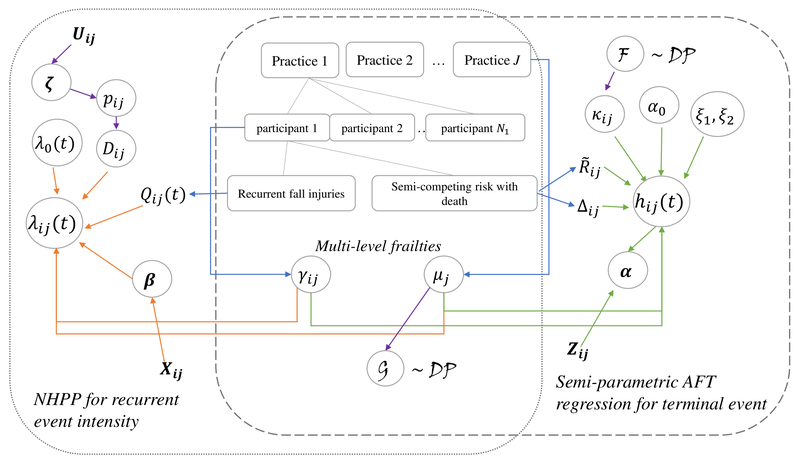
Beyond neuroimaging, this line of research develops Bayesian semiparametric methods for complex data structures arising in clinical studies. For clustered recurrent events with zero-inflation and terminal events, a flexible joint modeling framework is proposed that simultaneously captures the recurrent event process, zero-inflation, and the terminal event through multi-level frailties and Dirichlet process priors, enabling improved inference on treatment effects and patient heterogeneity.
Tian X., Ciarleglio M., Cai J., Greene E. J., Esserman D., Li F., & Zhao Y. JRSS-C, 73(3), 598–620, 2024.